
- One of the best ways to learn what works best in astrophotography is to experiment. I’ll be detailing my experiments which should help you to answer the questions you have in your own journey. Perhaps it will save you time and stress and speed up your own progress. Need ideas or want to collaborate?
- C/CS mount and one of the standard M42 x 0.75 mm spacers are designed for 1.25' mounted filters. These parts have an M28.5 x 0.6 internal thread.
Keith's Image Stacker is an image processing program that is oriented primarily toward astrophotography. See my astrophotography webpage for information about my personal venture into that hobby. What Keith's Image Stacker provides, more than anything else, is a workspace in which to align many similar images (say from a quicktime movie of Jupiter taken through a telescope with a webcam) and then to produce a stack of the images, which consists of a single image that comprises either the sum, or the average, or some value in between of the individually stacked images. Stacking images is a well-established method for increasing the signal-to-noise ratio in a series of similar images. True 'information' will shine through the stack, while random noise will drop out. Here's are some examples of what can be accomplished with this program: One frame (above, left), stack of 61 such frames with various processing (above, right) Keith's Image Stacker is 'uncrippled' shareware. For the endless hours of work I have put into creating this utility I ask that you please pay me $15.00, which automatically registers you for all future versions. In return I will place you on an extremely infrequent mailing list to be directly notified of version updates when they occur. Specific instructions for paying can be found in the README file that is bundled with the program. Thank you. Thank you, and please contact me and tell me what you think of this program. I would really like to know people's reaction to it. Publicity, RecognitionKeith's Image Stacker has received considerable publicity over the years. The following lists some of the more prominent examples.
DownloadMost of the configurations will actually run on any machine, but it is recommended that you download the configuration that best matches your machine. It will run faster and may alleviate bugs that occasionally occur when older configurations are run on newer machines. v5.0.1v5.0.1 for Intel Macs and OS 10.5 or later v5.0v5.0 for Intel Macs and OS 10.4 or earlier v4.2DocumentationThe program comes with documentation in PDF format. Alternatively, you may: | |
|
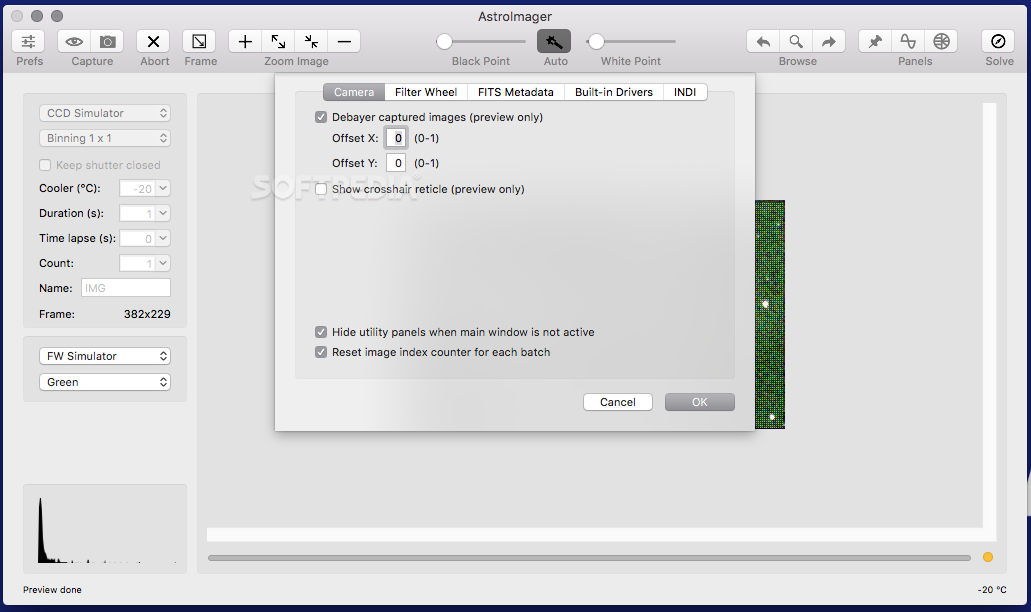
AstroImager is a powerful, but easy-to-use image-capture application for astrophotography. It can be used as a client to any remote or local INDI server with any supported CCD, filter wheel, or focuser. The built-in drivers support the following hardware: ATIK Titan Mono and Colour. Astro Physics 180 EDF Starfire & Apogee U-16M CCD Images From Cave Creek Canyon Observatory 2008 thru 2010. Cave Creek Canyon Observatory.
This is my quest: to follow that star ..
Last update: 12/25/08
The stars: distant suns. This site reflects the culmination of mypersonal quest to become an astroimager - an amateur astronomer whoseavocation is to capture images of the celestial wonders that pass overour heads, largely unnoticed, every day. Thus, this is the triumph of myquest to photograph the distant suns of our Universe - a sun quest.
This journey began with the construction of an observatory in the NewMexico desert, far away from the lights of major towns and hugecities. This resulted in theBunker Ranch Observatory.There you'll find pictures, descriptions, and accounts of the processof building the observatory, and information on the equipment used totake the images herein.
Your monitor should be adjusted in contrast and brightness so that all 21grayscale levels below are discernible. You may have to lower the roomlights to succeed at this. (Hint: use the 'brightness' controlto change the levels of black, and the 'contrast' controlto change the levels of white.)
Night Gallery (Picture, if you will, a dark sky ..)

We begin with the first astrophoto taken with the BRO's major instrument,a 400mm (16') Hypergraph.This is M13, the famous globular cluster in Hercules,in a 30-minute exposure with a Pentax 67 camera loaded with Ilford 3200film. Note the well-known 'X' across the center of the cluster.
Globular clusters (so-named for their roughly spherical shape)are very old; they were, in fact, the first large structuresto form at the birth of the Milky Way Galaxy about ten billion years ago.There are about 60 of theseclusters in a roughly spheroidal pattern co-centered with thegalactic disk.
An average globular contains perhaps 100,000 stars; M13 is rather largerthan that, containing several hundred thousand. One estimate even placesthe number of stars at over a million.
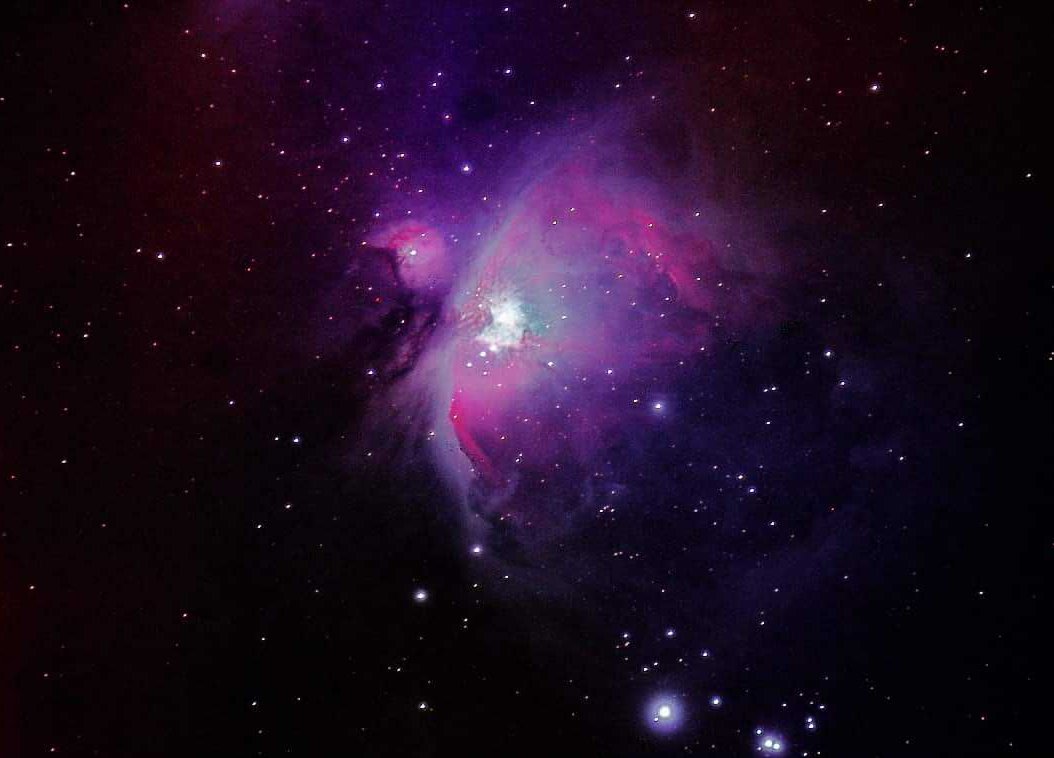
Below is the first color image taken with the observatory's STL-11000XMCCD camera. This is an LRGB composite of 5-minute images of the Flameand Horsehead Nebulas in Orion. The camera was attached to a Borg 125EDoperating at f/4 for a focal length of 500mm. Gravitee wars.
The glowing clouds here shine by fluorescence from the ultraviolet lightemitted by the hot blue stars in the area. The 'Horsehead'visible against the red cloud is a dark dust nebula that is absorbing thered light from the cloud.
Here is another color image of the same area, taken with the same camerabut a different telescope. The telescope used for this image is a TakahashiBRC-250, which is twice the diameter of the Borg 125ED (so it gathers 4 timesas much light), but also 3 times the focal length (so the'magnification' is 3 times higher). You'll note that there is morevisible detail here; you'll also note that my image-processing skills haveimproved somewhat over the previous image ..
The Bunker Ranch Observatory's blog has an article onhow this image was made.
The yellowish and reddish clouds in this image are huge clouds of hydrogengas inside the Milky Way Galaxy. The colors are different due to differingoverall chemical composition, with the red being more pure hydrogen. Theseare, of course, far thinner than the water-vapor clouds in Earth's atmospherethat you're used to seeing;the hydrogen clouds contain only a few dozen atoms in the volume of anaverage-sided room.
Astroimager Tutorial
This is an image of Comet Holmes -- a small comet out by the orbit of Jupiterthat came to fame with a sudden outburst of gasses that increased itsbrightness by more than a million times, and made it an easy naked-eyesight in late 2007. This is a short exposure designed to capture detailsof the comet's nucleus, within the faintly visible halo that was stilleasily visible as it grew larger than the Sun.

This image was taken with a Borg 125ED configured at 500mm f/4, with anSBIG STL-11000M CCD camera.
Again taken with the Borg 125ED and the STL CCD camera,here is a short (one-minute)exposure of the North America Nebula (NGC7000),demonstrating that a CCD camera cancapture images with far shorter exposure times than film (with some helpfrom a bit of digital image processing).
This is another one-minute image from the Borg 125ED and STL CCD camera -the Pleiades (M45). This is a fairly young association of stars that wereal born together out of the same gas cloud. The haze (blue in color images)around the starsis a dust cloud that the stars are passing through, unrelated to the gascloud where the stars were born.
Everything came together one night in November of 2008 -- the sky wasn'tthe blackest, and the seeing wasn't the steadiest, but the equipment alldecided to give me a break and work to perfection for oneshining moment. The result was this image of M33, a nearby spiral galaxy.
This is a composite of five 15-minute exposurestaken with the 400mm (16') scope, with some minimal imageenhancement to bring out some of the fainter detail. The full-sizeimage is large, but, I think, worth a look.
Astroimagej Pdf
And now for some more color - this is the Borg 125ED and STL CCD camera again;but here we combine four 20-minute images (one each in white, red, green,and blue light), to get a shot of the Rosette Nebula (the nebula is designatedNGC 2237; the open cluster of stars inside the nebula is NGC 2244).Note that this imageis only 1/4 the size of the original in width and height; that means theoriginal image has 16 times more data than seen here!(Well, actually, it's worse than that, because the original is 16 bits perpixel while this is only 8 bits per pixel. So the original really has 4,096times the data of this image - 4 times the resolution both horizontally andvertically, and 256 times the color information.)