
We can calculate the molar mass of NaCl by just adding the indiudual molecular masses of Na and Cl which is 58.4 and no of moles is 23.4 23.4= m/58.4, so m= 23.4. 58.4 (by rearranging) which is 1366.56g. 33 views Answer requested. The is no atomic number for NaCl (sodium chloride) as it is a compound and atomic nuber applies to elements. NaCl is made of the two elements sodium and chlorine. Sodium's atomic number is 11.
3.5 Formula Mass
Learning Objective
- Determine the formula mass of an ionic compound.
One skill needed in future chapters is the ability to determine the mass of the formula of an ionic compound. This quantity is called the formula massThe sum of the masses of the elements in the formula of an ionic compound.. The formula mass is obtained by adding the masses of each individual atom in the formula of the compound. Because a proper formula is electrically neutral (with no net electrons gained or lost), the ions can be considered atoms for the purpose of calculating the formula mass.
Let us start by calculating the formula mass of sodium chloride (NaCl). This formula mass is the sum of the atomic masses of one sodium atom and one chlorine atom, which we find from the periodic table; here, we use the masses to two decimal places:
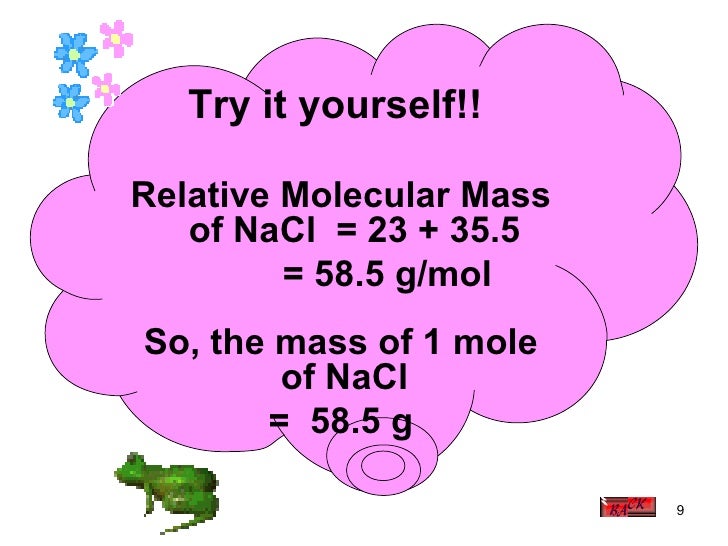
To two decimal places, the formula mass of NaCl is 58.44 u.
When an ionic compound has more than one anion or cation, you must remember to use the proper multiple of the atomic mass for the element in question. For the formula mass of calcium fluoride (CaF2), we must multiply the mass of the fluorine atom by 2 to account for the two fluorine atoms in the chemical formula:
| Ca: | 1 × 40.08 | 40.08 u |
| F: | 2 × 19.00 = | + 38.00 u |
| Total: | 78.08 u |
The formula mass of CaF2 is 78.08 u.
For ionic compounds with polyatomic ions, the sum must include the number and mass of each atom in the formula for the polyatomic ion. For example, potassium nitrate (KNO3) has one potassium atom, one nitrogen atom, and three oxygen atoms:
| K: | 1 × 39.10 | 39.10 u |
| N: | 1 × 14.00 | + 14.00 u |
| O: | 3 × 16.00 = | + 48.00 u |
| Total: | 101.10 u |
The formula mass of KNO3 is 101.10 u.
Note
Potassium nitrate is a key ingredient in gunpowder and has been used clinically as a diuretic.
Atomic Mass Of Naclo
When a formula contains more than one polyatomic unit in the chemical formula, as in Ca(NO3)2, don’t forget to multiply the atomic mass of every atom inside the parentheses by the subscript outside the parentheses. This is necessary because the subscript refers to the entire polyatomic ion. Thus, for Ca(NO3)2, the subscript 2 implies two complete nitrate ions, so we must sum the masses of two (1 × 2) nitrogen atoms and six (3 × 2) oxygen atoms, along with the mass of a single calcium atom:
| Ca: | 1 × 40.08 | 40.08 u |
| N: | 2 × 14.00 = | + 28.00 u |
| O: | 6 × 16.00 = | + 96.00 u |
| Total: | 164.08 u |
The key to calculating the formula mass of an ionic compound is to correctly count each atom in the formula and multiply the atomic masses of its atoms accordingly.
Example 9
Use the atomic masses (rounded to two decimal places) from the inside cover of this book to determine the formula mass for each ionic compound.
- FeCl3
- (NH4)3PO4
Solution
The formula mass of FeCl3 is 162.20 u.
When we distribute the subscript 3 through the parentheses containing the formula for the ammonium ion, we see that we have 3 nitrogen atoms and 12 hydrogen atoms. Thus, we set up the sum as follows:
N: 3 × 14.00 = 42.00 u H: 12 × 1.00 = + 12.00 u P: + 30.97 u O: 4 × 16.00 = + 64.00 u Total: 148.97 u The formula mass for (NH4)3PO4 is 148.97 u.
Skill-Building Exercise
AgBr
Fe3(PO4)2
Use the atomic masses (rounded to two decimal places) from the inside cover of this book to determine the formula mass for each ionic compound.
To Your Health: Hydrates
Some ionic compounds have water (H2O) incorporated within their formula unit. These compounds, called hydrates, have a characteristic number of water units associated with each formula unit of the compound. Hydrates are solids, not liquids or solutions, despite the water they contain.
To write the chemical formula of a hydrate, write the number of water units per formula unit of compound after its chemical formula. The two chemical formulas are separated by a vertically centered dot. The hydrate of copper(II) sulfate has five water units associated with each formula unit, so it is written as CuSO4·5H2O. The name of this compound is copper(II) sulfate pentahydrate, with the penta- prefix indicating the presence of five water units per formula unit of copper(II) sulfate.
Hydrates have various uses in the health industry. Calcium sulfate hemihydrate (CaSO4·½H2O), known as plaster of Paris, is used to make casts for broken bones. Epsom salt (MgSO4·7H2O) is used as a bathing salt and a laxative. Aluminum chloride hexahydrate is an active ingredient in antiperspirants. The accompanying table lists some useful hydrates.
Table 3.4 Names and Formulas of Some Widely Used Hydrates
| Formula | Name | Uses |
|---|---|---|
| AlCl3·6H2O | aluminum chloride hexahydrate | antiperspirant |
| CaSO4·½H2O | calcium sulfate hemihydrate (plaster of Paris) | casts (for broken bones and castings) |
| CaSO4·2H2O | calcium sulfate dihydrate (gypsum) | drywall component |
| CoCl2·6H2O | cobalt(II) chloride hexahydrate | drying agent, humidity indicator |
| CuSO4·5H2O | copper(II) sulfate pentahydrate | fungicide, algicide, herbicide |
| MgSO4·7H2O | magnesium sulfate heptahydrate (Epsom salts) | laxative, bathing salt |
| Na2CO3·10H2O | sodium carbonate decahydrate (washing soda) | laundry additive/cleaner |
Concept Review Exercises
What is the relationship between atomic mass and formula mass?
How are subscripts used to determine a formula mass when more than one polyatomic ion is present in a chemical formula?
Answers
Formula Mass Of Nacl
The formula mass is the sum of the atomic masses of the atoms in the formula.
The subscript is distributed throughout the parentheses to determine the total number of atoms in the formula.
Key Takeaway
- Formula masses of ionic compounds can be determined from the masses of the atoms in their formulas.
How To Calculate Mass Of Nacl
Exercises
What is the formula mass for the ionic compound formed by each pair of ions?
- Na+ and Br−
- Mg2+ and Br−
- Mg2+ and S2−
What is the formula mass for the ionic compound formed by each pair of ions?
- K+ and Cl−
- Mg2+ and Cl−
- Mg2+ and Se2−
What is the formula mass for the ionic compound formed by each pair of ions?
- Na+ and N3−
- Mg2+ and N3−
- Al3+ and S2−
What is the formula mass for the ionic compound formed by each pair of ions?
- Li+ and N3−
- Mg2+ and P3−
- Li+ and P3−
What is the formula mass for each compound?
- FeBr3
- FeBr2
- Au2S3
- Au2S
What is the formula mass for each compound?
- Cr2O3
- CrO
- PbCl2
- PbCl4
What is the formula mass for each compound?
- Cr(NO3)3
- Fe3(PO4)2
- CaCrO4
- Al(OH)3
What is the formula mass for each compound?
- NH4NO3
- H2Cr2O7
- Cu2CO3
- NaHCO3
What is the formula mass for each compound?
- Al(HSO4)3
- Mg(HSO4)2
What is the formula mass for each compound?
- Co(HCO3)2
- LiHCO3
Answers
The atomic mass of an element is the average mass of the atoms of an element measured in atomic mass unit (amu, also known as daltons, D). The atomic mass is a weighted average of all of the isotopes of that element, in which the mass of each isotope is multiplied by the abundance of that particular isotope. (Atomic mass is also referred to as atomic weight, but the term 'mass' is more accurate.)
For instance, it can be determined experimentally that neon consists of three isotopes: neon-20 (with 10 protons and 10 neutrons in its nucleus) with a mass of 19.992 amu and an abundance of 90.48%, neon-21 (with 10 protons and 11 neutrons) with a mass of 20.994 amu and an abundance of 0.27%, and neon-22 (with 10 protons and 12 neutrons) with a mass of 21.991 amu and an abundance of 9.25%. The average atomic mass of neon is thus:
Nacl Molar Mass G Mol
| 0.9048 | × | 19.992 amu | = | 18.09 amu |
| 0.0027 | × | 20.994 amu | = | 0.057 amu |
| 0.0925 | × | 21.991 amu | = | 2.03 amu |
| 20.18 amu |
The atomic mass is useful in chemistry when it is paired with the mole concept: the atomic mass of an element, measured in amu, is the same as the mass in grams of one mole of an element. Thus, since the atomic mass of iron is 55.847 amu, one mole of iron atoms would weigh 55.847 grams. The same concept can be extended to ionic compounds and molecules. One formula unit of sodium chloride (NaCl) would weigh 58.44 amu (22.98977 amu for Na + 35.453 amu for Cl), so a mole of sodium chloride would weigh 58.44 grams. One molecule of water (H2O) would weigh 18.02 amu (2×1.00797 amu for H + 15.9994 amu for O), and a mole of water molecules would weigh 18.02 grams.
Finding Mass Of Solute
The original periodic table of the elements published by Dimitri Mendeleev in 1869 arranged the elements that were known at the time in order of increasing atomic weight, since this was prior to the discovery of the nucleus and the interior structure of the atom. The modern periodic table is arranged in order of increasing atomic number instead.